25 November 2026
The latest AQ NED Exchange brought together aspiring and experienced non-executive directors, trustees and governors to explore a topic that many professionals find both essential and uncomfortable: networking.
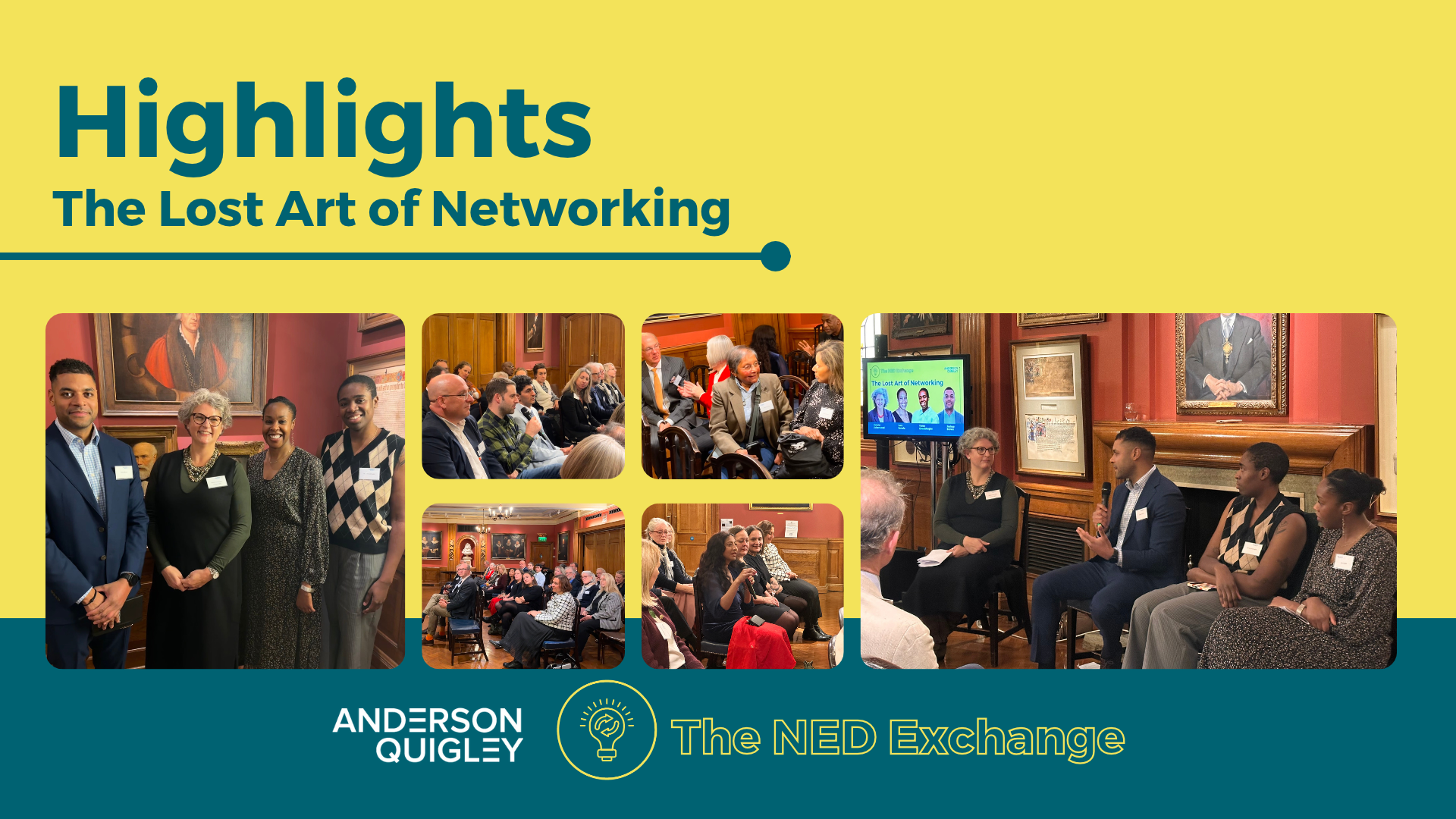
Hosted by Anderson Quigley and chaired by Helene Usherwood, Senior Partner, the discussion examined how authentic relationship-building can support progression into board roles, broaden professional horizons and create opportunities that might otherwise remain inaccessible.
The panel featured portfolio chair and non-executive director Lara Sonola, Yeme Onoabhagbe, CEO of Board Racial Diversity UK, and Joshua Brown, Director of C-Suite Networks at Winmark, who shared their experiences of building networks, developing board careers and supporting others to access leadership opportunities.
Moving beyond transactional networking
Opening the discussion, Hélène invited attendees to describe how networking made them feel. Responses ranged from “energising” and “useful” to “awkward”, reflecting the discomfort the term can sometimes create. Too often associated with elevator pitches and exchanging business cards, networking is better understood as building genuine professional relationships over time. Hélène emphasised that, while these relationships should never replace a fair and rigorous appointment process, they remain an important part of the board appointments landscape. Networks can influence who hears about opportunities, who is encouraged to apply and who has access to valuable advice, insight and support.
For Lara Sonola, Portfolio NED and Interim Transformation Leader, the most effective networking happens when there is no immediate objective in mind.
“You shouldn’t see networking as something where you need to have an aim in mind. I think you are better at networking when you are just thinking about building relationships, meeting people and most importantly trying to stay in contact with them.”
Reflecting on her own journey, Lara described how a professional relationship with Helene developed over many years, eventually leading to an invitation to join the panel discussion itself. That continuity, she suggested, demonstrates the value of investing in genuine connections rather than approaching networking solely as a route to the next opportunity.
Challenging assumptions about who belongs in the boardroom
Yeme Onoabhagbe, CEO at Board Racial Diversity UK, highlighted some of the structural barriers that continue to prevent talented individuals from accessing board opportunities.
As CEO, Yeme works with both aspiring board members and organisations seeking to create more inclusive governance structures. They encouraged attendees to think more broadly about the skills and experiences that boards need.
“We have a very traditional way to keep our skills that we bring to a board, and there are so many types of skills that you can bring, not just in professional background, your lived experience, and the people that you speak to day-to-day, your communities that you work with and the things you’re passionate about as well.”
Through Board Connect, a network of aspiring trustees and NEDs from Black and Asian backgrounds, Board Racial Diversity UK seeks to demystify governance roles and provide access to the informal knowledge that is often difficult to obtain through formal recruitment processes alone.
Yeme also reflected on the unpredictable nature of professional relationships, sharing examples of conversations that eventually led to board appointments, senior leadership opportunities and successful recommendations years later.
“You just never know what a conversation could lead to.”
Why networking is a long-term investment
A recurring theme throughout the discussion was the importance of patience and consistency.
Joshua drew on his Winmark experience where peer communities are designed to facilitate learning, collaboration and professional growth. He argued that individuals who gain the most value from networks tend to share three characteristics: openness, vulnerability and intentionality.
He also challenged the assumption that successful executive careers automatically translate into non-executive appointments.
“When you speak to chairs, and you speak to those that are on boards, it’s a really difficult jump to make.”
Networking, therefore, should not be viewed as a short-term strategy for securing a board position. Instead, it forms part of a longer process of becoming visible, building credibility and developing relationships with people who understand your strengths and aspirations.
The panel agreed that intentional follow-up is often more important than the initial introduction. Maintaining contact, continuing conversations and finding opportunities to support others all contribute to stronger and more meaningful professional networks.
Finding an authentic approach
For many aspiring board members, networking can feel particularly challenging.
Lara described herself as an “extroverted introvert” and acknowledged that networking is often something people learn rather than something they naturally enjoy.
Her advice was to approach networking as a skill that develops through practice and repetition.
“Networking, it’s not a natural skill; it’s something you can develop, and I think if you look at it as a skill that you build over time, you get better at it.”
She also encouraged attendees to resist copying other people’s approaches and instead find methods that align with their own personalities and strengths.
“The key thing for me is to really lean into what is authentic for you.”
The discussion highlighted practical ways to make networking feel more natural, including using questions as conversation starters, taking an interest in other people’s experiences and focusing on learning rather than self-promotion.
LinkedIn, mentors and expanding horizons
The panel also explored how digital platforms can support professional relationship-building.
Yeme described LinkedIn as an increasingly powerful networking tool that enables professionals to discover events, make new connections and maintain visibility within their sectors and beyond.
Lara echoed this view, explaining how a mentor encouraged her to take LinkedIn more seriously as she developed her portfolio career.
“If you want to get into portfolio NED, you need to start building your profile on LinkedIn.”
She also advocated building a network of mentors who can offer guidance, challenge assumptions and provide valuable perspectives at different career stages.
Another important theme was the value of stepping outside familiar sectors. Both Yeme and Lara spoke about attending events unrelated to their professional backgrounds and accepting governance opportunities in areas where they had little direct experience. These experiences often provided fresh perspectives and generated some of the most valuable connections.
Purpose, curiosity and contribution
As the conversation drew to a close, the panel reflected on the importance of understanding personal motivation.
Joshua encouraged attendees to think carefully about what energises them and what impact they want to have through board service.
“Really consider your purpose. What is it that makes you get up in the morning or motivates or energises you?”
He also suggested assembling a personal “board of advisers” made up of trusted colleagues, mentors and peers who can provide honest feedback on strengths, opportunities and development areas.
The discussion concluded with a clear message: successful networking is not about collecting contacts or delivering perfect introductions. It is about curiosity, generosity and authentic relationship-building over time.
For those seeking their first board appointment or looking to expand an existing portfolio, the panel’s advice was simple: be open to conversations, invest in relationships and remember that today’s informal discussion may become tomorrow’s unexpected opportunity.
Next Generation Boards: Insights from Industry Leaders | AQ
Anderson Quigley Board practice works with organisations to widen talent pools, assess potential alongside experience, and identify candidates who can bring fresh thinking while strengthening governance capability. If you’re looking for an inclusive and forward-thinking approach to your Board, drop Helene Usherwood a line for an open and confidential discussion at helen.usherwood@andersonquigley.com