
17 June 2026
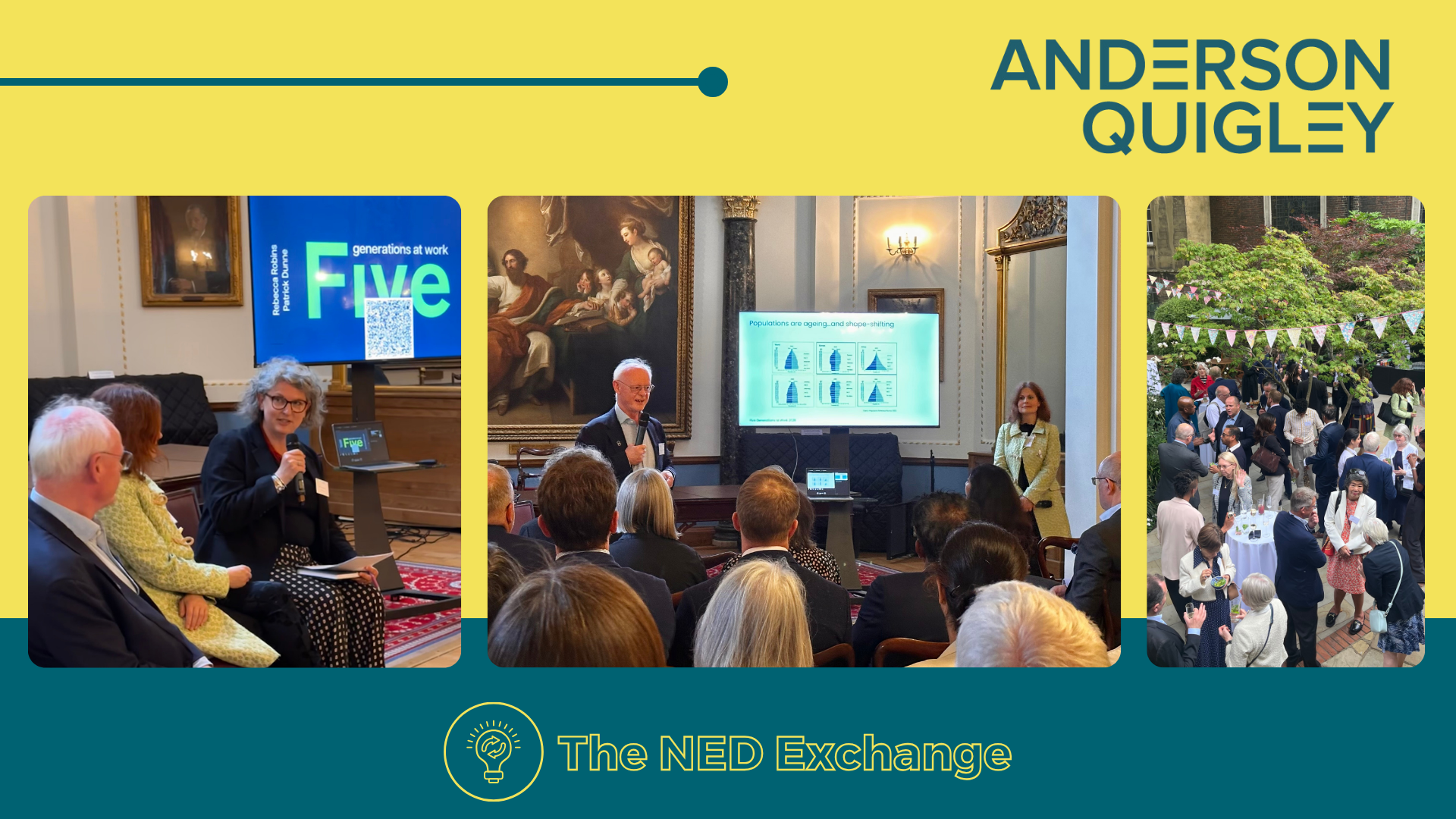
As organisations across sectors grapple with succession planning, board effectiveness and the need for broader perspectives in governance, we brought together board leaders and governance practitioners to explore what the next generation board should look like in our latest NED Exchange event.
We were honoured to be joined by award winning authors, Rebecca Robins and Patrick Dunne, co-authors of Five Generations at Work: How We Win Together for Good. Helene Usherwood, Senior Partner and Anderson Quigley’s Board Practice Lead, led the conversation with our guests to explore what should the “next generation board” actually look like?
The themes raised reflected challenges Anderson Quigley encounters regularly through its board appointments and governance advisory work. While organisations increasingly recognise the value of diverse perspectives, many continue to wrestle with how to identify, attract and integrate new voices in ways that strengthen board effectiveness.
Helene made it clear to the audience the scope of the discussion:
“Now, this isn’t simply in terms of age, or a more modern looking skills matrix. But in terms of how boards bring together different experiences, backgrounds, generations, ways of thinking. And that makes that diversity really count as well. The challenge is not just on how to attract new voices into the boardroom. It’s about how to select well on board properly. Listen generously, and manage constructive tension, and build boards that are genuinely effective rather than merely representative.”
How can generations work together
Rebecca began with an emphasis that the coexistence of five generations at work represents a rare and valuable opportunity rather than a problem to fix, highlighting that the real issue lies in misunderstanding context between generations. She reminded the audience that a generation is not just a cohort of people born within a defined period; it is shaped by events, environments and shared experiences spanning from geopolitical conflict to technological change and that age alone is not the defining trait of what brings people together, or divides them.
She highlighted how organisations can unlock growth and relevance by deliberately bringing generations together and combining perspectives, experiences and expectations to create value that surpasses what any one group could achieve alone.
Patrick illustrated the point through global demographic shifts. With populations ageing across much of the developed world and expanding rapidly in regions such as Africa, generational dynamics are becoming more complex and more consequential. Echoing Rebecca, he too noted that lived experience varies profoundly even within the same age group, shaped by geography, culture and circumstance. He argued that traditional generational labels and stereotypes are too simplistic, as lived experiences vary widely across geography, culture and historical events.
Instead, he advocates for a more nuanced understanding of individuals. Drawing from his time with the Royal Voluntary Service, he described an 83-year-old volunteer mentoring an 18-year-old on her first day, appearing as total opposites in every way but easily finding common ground between them.
The audience was urged to adopt “lenses, not labels.” Understanding individuals through careful listening and curiosity was presented as the foundation for effective intergenerational working. The emphasis throughout was on a “maximising mindset”: seeking out the strengths everyone brings, rather than filtering them through assumptions.
Getting it right
The discussion then turned to how organisations are attempting to formalise these interactions through governance structures. Increasingly, organisations are experimenting with next generation boards, youth advisory groups and multigenerational governance models. Audience contributions highlighted practical initiatives, from bringing university students onto regional boards to embedding young trustees within existing governance structures.
Patrick shared an example of an organisation that is getting it right. At the Port of Tyne, a multigenerational “next generation board” has been integrated into the organisation’s strategic thinking, contributing directly to innovation and operational development. Siemens, meanwhile, has adopted “Siemens Challenger Committees”, groups of younger employees tasked with offering fresh perspectives to executive teams. Both cases underline a key lesson: these initiatives succeed when they are embedded in real business challenges, not positioned as peripheral exercises.
Rebecca highlighted the importance of language in this context. Terms such as “shadow board” can unintentionally reinforce hierarchies and undermine the perceived value of participants. More effective approaches, she suggested, frame these groups as partners – contributors to leadership and strategy rather than passive observers.
Other examples reinforced the importance of intentional design. Rebecca spoke of The Financial Times’ next generation leadership initiative pairs participants with board members, fostering mutual mentoring rather than one-way development. She also noted Gucci’s use of a millennial advisory group during a period of rapid brand growth illustrated how generational insight can inform strategic transformation, particularly when linked to customer understanding.
So what can Boards do?
Across these cases, several common principles emerged. Purpose matters, successful initiatives are tightly aligned with organisational strategy, not bolted on as standalone projects. Tokenistic approaches, such as appointing a single young representative to a large board, rarely achieve meaningful impact. Finally, mutuality is critical. The value flows both ways: younger contributors gain exposure and experience, while boards gain insight, challenge and renewed legitimacy.
The role of leadership, particularly the chair, was also emphasised. Creating the conditions for effective participation requires preparation, encouragement and feedback. Practical steps such as pre-meeting conversations, inviting contributions during discussions and offering reflective feedback afterwards can make a significant difference, especially for those new to board environments.
The importance of creating psychological safety as a foundational requirement, was also discussed. Without a genuine commitment to openness, trust and respectful challenge, intergenerational initiatives risk becoming performative. The panel noted that organisations must move beyond rhetoric; inclusion must be embedded in how they operate, not treated as an additional programme.
The conversation also challenged some common assumptions. One recurring theme was the idea that younger generations are inherently more “AI fluent” or digitally capable. While there may be generational differences in exposure to technology, the speakers cautioned against reductive thinking. Skills and insights are distributed more widely and more unpredictably than such narratives suggest.
Questions from the audience expanded the discussion further. Recruitment emerged as a particular challenge: how to attract a genuinely diverse mix of candidates, rather than those already well versed in navigating career opportunities. Helene offered advice of rethinking where roles are advertised, adapting application processes to be more accessible and focusing on potential and perspective rather than prior board experience. As one participant observed, the responsibility does not rest solely with institutions. Individuals also have a role to play, mentoring, encouraging and creating opportunities for others to step forward
Ultimately, the evening returned to a central idea: intergenerational collaboration is not an optional extra. It is increasingly fundamental to organisational success. Building effective next generation boards requires intention, patience and a willingness to rethink established practices. But the direction of travel was clear, organisations that move beyond stereotypes, invest in genuine collaboration and create the space for new voices to contribute will be better positioned to navigate future challenges.
For boards, the question is no longer whether they need broader perspectives, but how they build governance structures capable of harnessing them effectively – a challenge that will continue to shape board recruitment, succession planning and leadership development in the years ahead.
Anderson Quigley Board practice works with organisations to widen talent pools, assess potential alongside experience, and identify candidates who can bring fresh thinking while strengthening governance capability. If you’re looking for an inclusive and forward-thinking approach to your next generation Board, drop Helene Usherwood a line for an open and confidential discussion at helen.usherwood@andersonquigley.com.
Highlights from the NED Exchange Event: Mastering the art of public sector board leadership | AQ

13 October 2026


8 October 2026


6 October 2026