


23 April 2026
We were delighted to host our latest Women in Tech earlier this week in partnership with London Business School. Our esteemed panel, with their wide breadth of experience, knowledge, and perspective, discussed how organisations can thrive in the age of digital transformation.
We began with our keynote speaker, Keyvan Vakili, (Associate Professor of Strategy and Entrepreneurship; Academic Director, Data Science and AI Initiative at LBS) who delivered an incredibly insightful presentation on “The AI Productivity Paradox”. He presented research and case studies which highlighted how generative AI tools like ChatGPT have shown significant productivity gains at the individual and team level, but these gains are not yet reflected at the macroeconomic or organizational level, with a particular focus on the “persuasion trap”, which demonstrates the risk of AI-generated outputs being persuasive but not necessarily correct, showing that users can be convinced by confident but incorrect AI responses, especially when lacking domain expertise, which can lead to organizational risks and misaligned decisions.
He advised the audience to invest in what will become scarce and valuable in the future: judgment, expertise, trust, governance, organizational design, stakeholder management, and strategic alignment. The technology will keep evolving and as that does, things like tool development, analysis, content production, code generation will become cheap and easily accessible.
“What will really make a difference is training the staff and the employees of the companies for exercising their judgment and expertise, thinking about processes, not just tasks and individuals”
Femi Otitoju, (Founding Partner at Challenge EDI) expertly chaired our panel once again, comprised of Briony Barham (Executive Director, Service Management & Campus Technology at LBS), Karen Bates (Chief Digital and Information Officer at LBS), Kate Boyle, (Senior Data Advisor at the Cabinet Office and Director, Data and Analytics at Police Digital Service), Grace Tattersall (Partner and Technology Practice Lead at AQ) and Margo Urban (Head of Application Development and Support at LBS)
She guided them through discussions around the shift in what’s needed in digital leadership today, the importance of focusing on the people aspect and putting organisational culture at the forefront of digital transformation, working with data and analytics on a large scale and turning strategy into something that actually works in practice and the future of talent in the tech industry – particularly around getting and retaining more women in the digital workforce.
The shifting role of the CIO/CDIO
Karen argues the CIO/CDIO role still needs technical credibility, but success increasingly depends on leading people, culture and organisational change. Leaders must be present in executive conversations early to ensure technology implications, choices and risks are understood before decisions harden. The others agreed, stressing that no one leader can keep pace with every domain (digital, data, cyber, AI). Thriving leaders build strong teams of deep specialists, know what they must understand personally, and create decision pathways that surface expertise quickly.
Getting leadership and governance right
Grace notes many organisations still lack digital representation at board level, a persistent issue that isn’t easily changed. She also critiques “unicorn” job specs that ask for an impossible skill set, reinforcing gender bias because women commonly self-select out if they don’t meet every requirement. Grace urged the women to push through that self-doubt and remember what they are capable of.
Transformation is about your political and human element, not just the technical element. And that has changed a lot. I think over the last 10 years, it always was the tech. But now it’s got to be about people. – Grace Tattersall
What “thriving” looks like
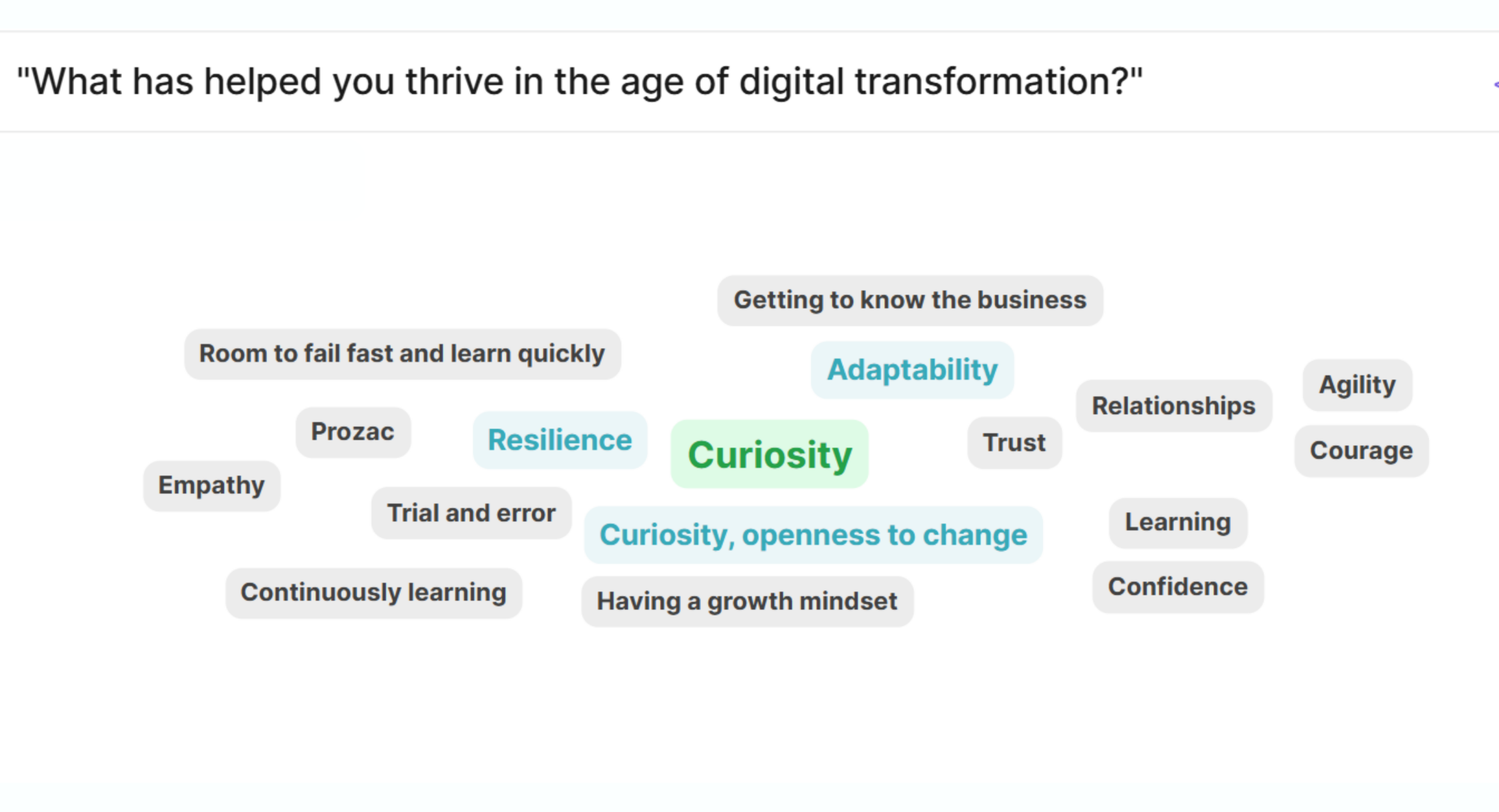
Answering Femi’s question, Briony described thriving as a learning culture where people accept they can’t know everything all the time and rely on their team to fill in the blanks. She also encouraged us to approach with curiosity, explore uncertainty and learn continuously – asking questions every day.
Margo added that asking questions is a strength particularly for women, but fear of judgement can suppress it; encouraging leaders should model openness. Kate made the important point “protecting other women in every environment” supporting the questions and ideas of the women on your team so the credit goes where it is due.
“When you are open about asking questions with your team and showing the right behaviours, you are leading the way, you are showing what is, what it should be, what your day to day should be effectively.” – Margo Urban
Leading through constant change
Briony echoed a colleague who promotes the concept of “freedom within the frame” in which leaders set outcomes and constraints, then co-create the route with teams, allowing them the freedom to find their own route to the destination they are working together to achieve.
Karen adds that autonomy can feel risky for teams used to structure because it increases accountability and ambiguity. Leaders should pace the shift: build confidence, acknowledge change fatigue, and invest in digital capability, especially where long tenure means expectations have moved faster than skills.
More than once our panellists shared the sentiment that “technology is the easy bit”; the hard part is adoption. From stakeholder engagement, executive alignment and culture, leaders must work through change fatigue and actively support new expectations rather than assuming people will simply adapt.
Actually making the transformation
Briony shared a common issue see sees: when the business decides on a solution without approach the tech team to discuss how that solution can be achieved. Margo echoed her sentiment, citing the demand management process, giving the example of when a new shiny tool has been bought but often isn’t even be needed and with communication between the teams the solution could have been found before the shopping list was ticked off.
“It’s not perfection, it’s trial and error, test, learn, fail fast, rectify quick. It’s for me about understanding the actual business problem, whether you’re in public sector, whether you’re in finance, whatever sector you’re in, what does the business need?” – Kate Boyle
AI, bias, and trust
AI was obviously weaved into every discussion, both with interest and caution, and Keyvan’s sentiments were echoed many times.. Kate warned against uncritical use when outputs are biased or context-poor, and highlights risks from unrepresentative training data that can reinforce inequities.
With executives, the panel recommends outcome-led framing (“save money” rather than “do AI”) and proving value through a small number of well-defined use cases. Karen added that in a recent board meeting she was asked what could be done to support her role. Her response? “Be realistic about what we can achieve, there is almost a race to see who can show that they are leveraging the most value from AI and there is a need from the executive and board level to understand what they are doing with AI”
“There was a point in time not long ago, open AI and Anthropic was on par in terms of what they offered, but we’ve seen huge divergence in terms of specialism of the tooling. So I think there’s an element of, do you want to be the first adopter or do you want to be the fast follower?” – Karen Bates
Legacy and alignment
Margo shared that the hardest part is alignment: shared language, definitions, assumptions and context across business and technology. Without this foundation, delivery friction appears as avoidable rework and “difficult behaviour.” Legacy can also be an organisational risk (e.g., one remaining expert on an old system). The panel distinguishes digitisation (tool replacement) from transformation (operating model and process change).
“A CIO I used to work with would talk about the “five why’s”. When someone comes to you with an idea, ask ‘why’ five times . It proves they have a depth of understanding and haven’t just come up with this off the top of their head. You are comfortable knowing that you can trust this idea and they feel comfortable because they’re presenting you with a fully fledged idea.” – Briony Barham
Building capability and retaining women
For future relevance, Karen emphasised adaptability: curiosity, experimentation and acceptance that change is continuous, not a one-off programme. Roles will keep evolving, so organisations should support people to build new skills and move across disciplines.
On retaining women in digital roles, Grace stressed systemic design: diverse longlists and panels, clearer mandates and role context, parity with peer leaders, and HR policies that reflect life stages and caring responsibilities (including menopause support). Retention improves when people feel supported and safe to contribute.
Asked for the most important factor in transformation, the panel offers: adaptability, flexibility, data, people and resilience.
The conclusion is that thriving is less about chasing tools and more about leadership, culture, governance and learning habits that enable sound decisions and sustained delivery.
Women in Tech: Empowering Voices and Perspectives | AQ
Grace Tattersall would like to thank everyone for attending the event, and supporting the AQ Women in Tech network. If you would like to attend future events, please request to join the AQ Women in Tech network via LinkedIn.


13 October 2026


8 October 2026


6 October 2026