8 October 2025
We were delighted to host our latest Women in Tech event last week, in partnership with the University of London, at their iconic Senate House building. Our esteemed panel comprised both new and familiar faces, creating a group with a wide breadth of experience, knowledge, and perspective to discuss our three topics at hand: Bias in AI, Menopause Awareness Month, and Succession Planning.
Our opening speaker, Rita Akushie, Pro Vice-Chancellor, Finance and Operations at the University of London, set the scene of the event, stating that “change doesn’t happen in isolation; it happens in rooms like this, when we come together with curiosity and courage”. She invited the audience to do three things:
Bias in AI
Our keynote speaker, Dr Anna-Maria Sichani, BRAID Fellow – Research Associate in Digital Humanities at the University of London, then delivered an incredibly insightful presentation on “Bias in AI,” where she argued that AI is far from neutral because power structures and biases shape it. She detailed how every system, tool and platform is created by humans who inevitably carry their own histories, perspectives and biases. “So these values, these assumptions become embedded in the design choices, the data that is collected, and the ways the technology is deployed.”
Femi Otitoju, Founding Partner at Challenge EDI, was once again our brilliant chair and expertly guided the panel through our discussion topics, first continuing the discussion started by Anna-Maria. Yvonne Hanson Mills, Chief Information Officer at Art Fund, brought up user awareness in AI usage, adding, “There’s a lot of pressure for organisations to adopt AI, but the question is, are they really aware of some of the issues that you’ve highlighted, so I think that user awareness is quite key and we don’t talk about it enough, certainly in the media and across the UK.”
Seema Chauhan, Associate Director, Enterprise Architecture at the University of London, shared about UoL’s AI policy, “We’ve made sure that it’s been built around quite a lot of this. From senior management down, there has been much emphasis on understanding that bias is built into the data. So responsible usage of AI and what it’s been built on, and understanding, so we fix the problem.”
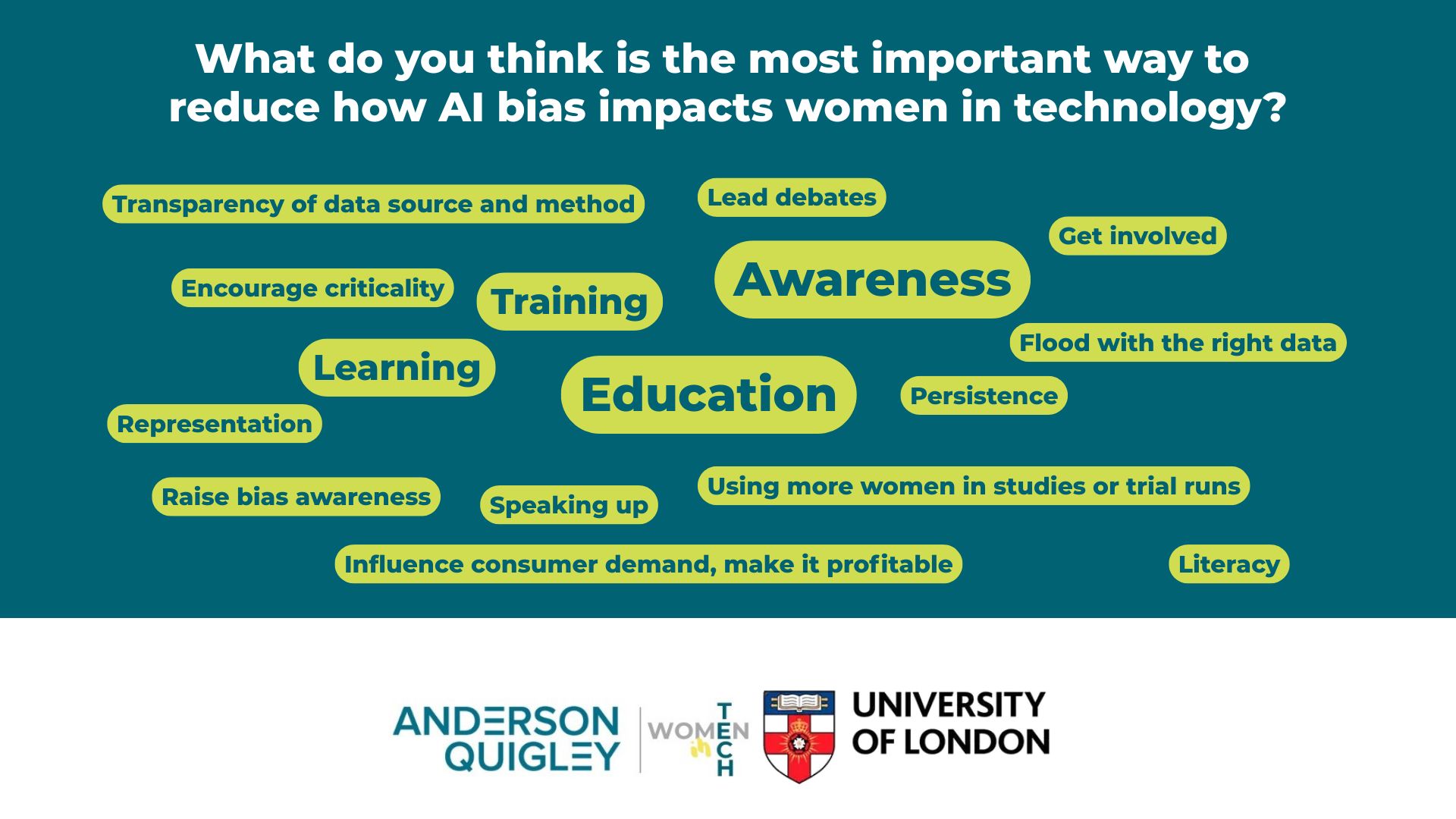
Femi invited the group to share a word or two in response to the question, “What do you think is the most important way to reduce how AI bias impacts women in technology?”
Menopause Awareness Month
As we moved into our discussion on Menopause Awareness Month, Femi asked our panel about the lack of conversation around menopause – even as policies are introduced into the workplace, why is there still such a reluctance to engage in day-to-day conversations?
Richard shared how, even growing up in a house with women, menstrual cycles were never discussed, and Yvonne mentioned how, even in her family, the women didn’t discuss menopause. If it is taboo in our personal lives, it will be taboo in our professional lives.
Our panel agreed that there was a big need for allyship and discussed how to engage male allies in the conversation. Yvonne said, “Menopause is a real issue for the majority of our workforce. I’m very aware of the impact it has on me sometimes in my workplace. I think you need allies and that’s quite a challenge to unpick because it’s almost been seen as taboo over the years.”
Grace Tattersall, Partner at Anderson Quigley, shares her experience of menopause training that AQ conducted to break that taboo, “before we put policy in place, we needed to educate, so we had some training sessions for managers so that they could support us as women, and to make it more aware and less uncomfortable for everyone.”
One audience member shared her story of losing her job due to her menopause symptoms, but urged us all to flip the narrative. While she does experience hot flashes and struggles with imposter syndrome, she is also strong and experienced, with a wealth of experience and dependability behind her. Grace strongly agreed, saying, “If we want to keep women with decades of experience and skills in the workforce, we have to work to empower women who don’t have the confidence to apply for more senior roles and grow due to menopausal symptoms and find those reasonable accommodations, support networks, and allies to make it happen”.
Succession Planning
What can we do to keep women in the workforce? Our panel and audience offered many ideas as to the reasonable accommodations that can be made to help women, particularly menopausal women, succeed.
Femi asked our panel what it could look like in the future, 5 or 10 years from now, if workplaces handle and support menopause well, where are we headed if we get it right?”
Yvonne emphasised the importance of hybrid working, allowing people the autonomy to have a calmer day when brain fog or fatigue is particularly challenging. Grace agreed, citing the ageing workforce as the retirement age continues to be pushed back, which means accommodating a variety of needs and hybrid working can help on several fronts. Seema carried on with that thought, recommending an emphasis on diversity and cross-generational mentoring, “if you see a woman who’s at that age in her life, but she’s doing well and is flexible working and supports her, then you’re more likely to think, oh, I can do this. I’ve seen this. This can work for me.”
Allyship
Allyship was a strong theme throughout the event, but Richard Michel, Chief Information & Digital Officer at the University of London, rounded off the event by sharing his story of working for one of the few female IT directors in the 1980s and the challenges he saw firsthand from a female perspective. “We would go to vendor conversations where they would speak to me even though she was introduced as the IT director, and I was just a developer. And that taught me a lot about the challenges for women working in any workplace, but in particular in those male-dominated areas with expectations of a macho culture. Some of those have changed, but some haven’t, and I think that’s something we really do need to keep recognising and fighting to change in terms of the way we interact in the workplace.”
Grace Tattersall would like to thank everyone for attending the events, and supporting the AQ Women in Tech network, urging everyone to talk to their networks, talk to colleagues, talk to your male allies; this session taught us that communication and knowledge are key – don’t just unquestioningly believe the AI data, as Dr Anna-Maria told us; AI does not take place in a vacuum. We still need a human in the loop in these processes.
If you would like to attend future events, please request to join the AQ Women in Tech network via LinkedIn.