Appointment of the Chief Technology Officer

University of Law

Apply now

Welcome

A Message from the Vice-Chancellor & CEO

Dear candidate

Thank you for your interest in joining The University of Law as our Chief Technology Officer.

We consider this role one of the most exciting leadership opportunities in UK higher education. As our University continues to evolve and grow,  technology is playing an increasingly central role in how we deliver an outstanding experience for our students, how we support our colleagues, and how we achieve our ambitious strategic goals.

We are seeking an exciting and exceptional leader who recognises that technology is not simply an operational service, but a strategic enabler of innovation, growth and transformation. The Chief Technology Officer will join the Executive Board as a trusted partner, helping to drive the future direction of the University while ensuring that technology, data and artificial intelligence are embedded responsibly and effectively across every aspect of our institution.

The successful candidate will inherit a strong platform from which to build. However, we are looking beyond operational excellence. We are seeking someone with the vision to challenge convention, the credibility to influence at Board level, and the leadership to inspire colleagues across the University. This role demands an individual who can combine strategic thinking with practical delivery, creating a technology function that is agile, resilient, customer-focused and recognised as a catalyst for institutional success.

At The University of Law, our purpose is clear: to transform lives through education. Technology has a fundamentally important role in achieving that purpose—enhancing learning, enabling innovation, supporting our people and ensuring we remain competitive in a rapidly changing educational landscape. We believe artificial intelligence, data and digital capability present significant opportunities, but only when underpinned by strong governance, ethical leadership and a relentless focus on the needs of our students and colleagues.

Above all, we are looking for a leader who shares our values, embraces collaboration and is excited by the opportunity to help shape the next chapter of our University’s journey. If you are motivated by leading meaningful transformation at scale, influencing institutional strategy and building high-performing teams that make a lasting difference, I encourage you to consider this opportunity.

I look forward to welcoming our new Chief Technology Officer to the Executive Board and working together to realise our ambitious vision for the future.

Professor Andrea Nollent
Vice Chancellor and Chief Executive Officer

About ULaw

At The University of Law, we’re proud to stand out from the crowd as a purpose-driven private education provider. Our mission is clear: to be the University of choice for the professions, driving innovation in applied education and delivering outstanding outcomes for our students… and that’s where you come in.

Our commitment to driving innovation in higher education and delivering successful outcomes for our students has created a platform to diversify into aligned professions including business, criminology, policing and psychology. We operate through a unique network of national and international campuses and partnerships alongside a rapidly growing online provision.

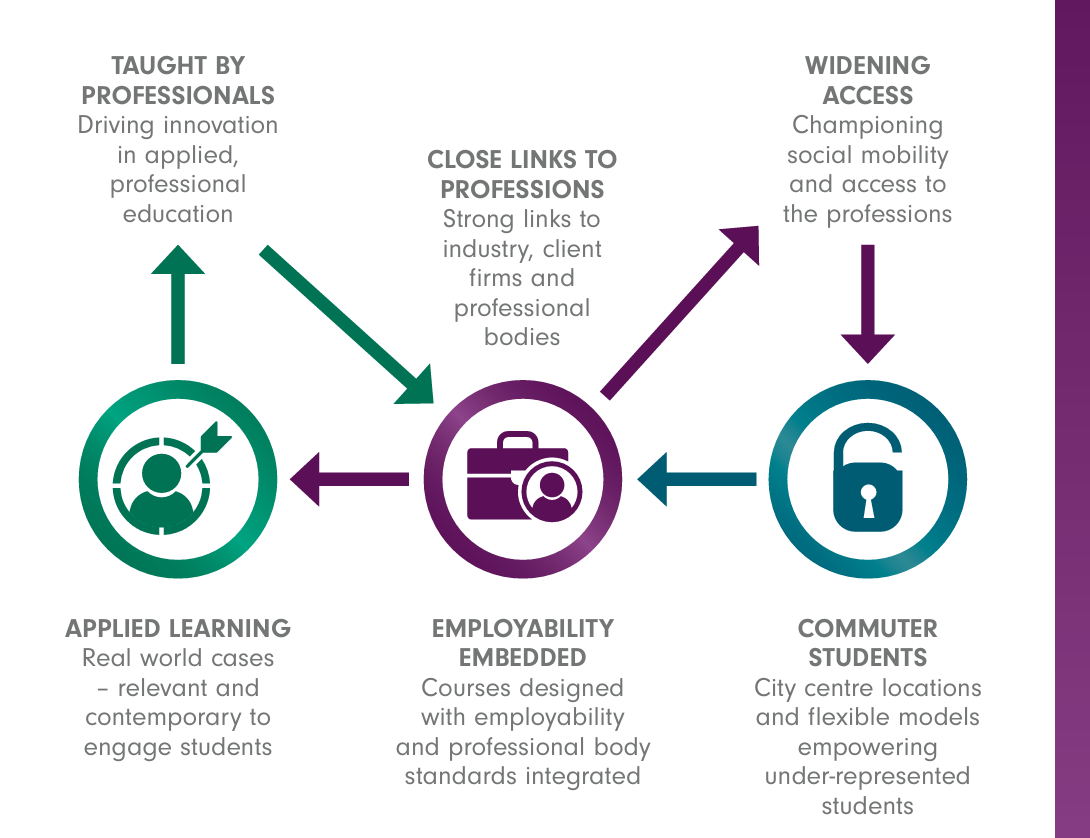
Through our close links and working relationships with professional bodies, combined with our world class teaching excellence, we continue to ensure that our students graduate with the highest employability prospects.

We remain deeply committed to supporting greater social mobility and access to the professions, contributing to a more diverse, fair and inclusive society through our distinctive, professionally focused academic model.

We’re now at the heart of higher education as an acknowledged leader in innovative, professional legal and business teaching for prospective lawyers and business professionals, both in the UK and worldwide.

In joining ULaw, you’ll be part of our journey to strengthen a culture of collaboration, inclusivity and flexibility where colleagues are supportive, professional, passionate and driven to help each other succeed. We offer a fast-moving workplace where you’ll be encouraged to grow, drive continuous improvement and make meaningful impact.

Whether your role is face-to-face with our students, driving our central business services, or leading change, your contribution is valued, and your impact is real.

This is where, together, we are driving change and changing lives.

Welcome to The University of Law.


History & heritage

Celebrating 150 Years of Legal Education

This year, we are proud to celebrate 150 years of legal education, a milestone that reflects our rich heritage and our long‑standing commitment to shaping the future of the legal and business professions.

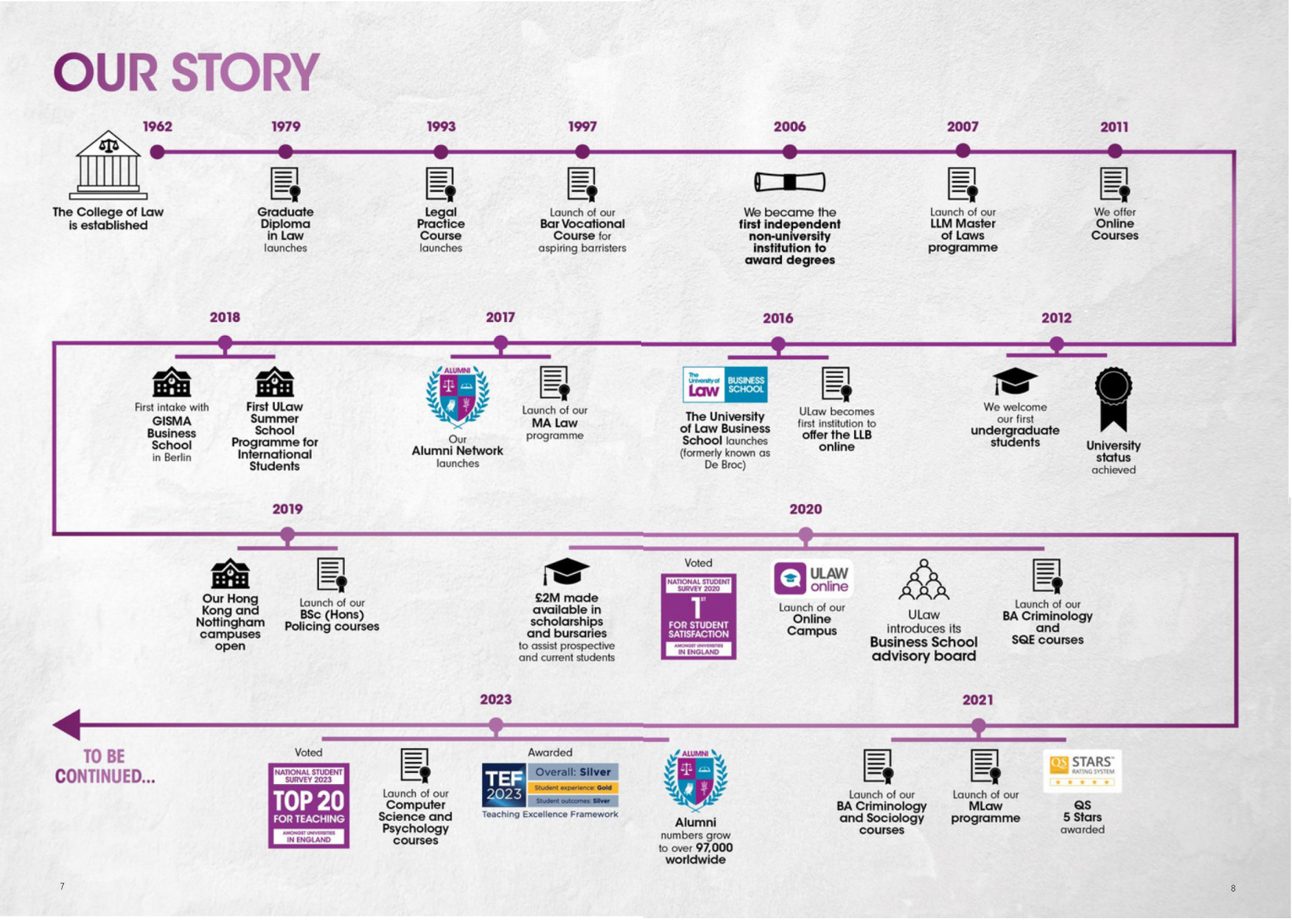
Our story began in 1876 with the formation of the leading tutorial firm Gibson & Weldon, followed by the establishment of The Law Society School of Law. These two influential institutions combined in 1962 to establish The College of Law, laying the foundations for what we are today.

We’ve continued to make history, becoming the first independent institution to be granted degree‑awarding powers by the Privy Council in 2006, a landmark moment that led to the development of our professionally focused LLB and LLM degree programmes.

Our evolution continued in 2012 when we achieved full university status, followed by the launch of our Business School in 2016, which has since expanded across our campuses and through international partnerships. In 2020 we launched ULaw Online providing a high quality and flexible way for students to achieve their ambitions no matter where they are.

Since 2020 we have further expanded our programme offering, launching courses in Criminology, Computer Science and Psychology, along with an MBA programme.

In 2021, we were awarded 5 stars overall and 5 stars for Law in the QS World University Rankings, as well as 5 stars in Teaching, Employability, Online Learning, Academic Development and Inclusiveness, a testament to the excellence that defines our community.

As we mark 150 years of legal education in 2026, we remain at the forefront of professional education and continue to develop the best legal minds and industry leaders.


What make us different

What really sets us apart from other universities is the guiding principle that future lawyers and business leaders should learn in a realistic, professional and contemporary context, with plenty of practical interactive engagement. That’s why we keep our contact hours high and our teaching groups small.

Innovative and Contemporary Teaching Practices

All of our courses – from our undergraduate law degrees to our diverse range of business courses and postgraduate programmes – are designed with a unique, varied and innovative learning approach proven to deliver self-reliant professionals who can compete in the fast changing professional world. With a focus on developing skills in problem-solving, weighing up arguments, critical thinking and commercial awareness, our courses are designed to prepare you for the real-life challenges of the working world.

Powerful Connections

Our track record of excellence in learning and development has helped us establish worldwide connections within the legal and business industries. This is why many leading global law firms and businesses work exclusively with us to develop their people, and why employers of all types want to meet our students. It’s why law schools and professional bodies around the world choose to enter into strategic alliances with us.

We have a vast network in the legal industry, providing legal training for 90 of the top 100 law firms in the UK and exclusively delivering SQE training for over 65 leading UK and US law firms, including those listed below.

Our many international partnerships allow us to provide a rounded, global outlook to business and law.

World Class Teaching

More than 250 of our lecturers are qualified lawyers and business professionals, and all have extensive practical experience which they are able to pass on to our students. We facilitate this process with high levels of student-to-lecturer contact time and small class sizes – one of the reasons that many firms insist their trainees study with us.

Focused on Employability

We focus exclusively on practice-based training and give students access to our expert Careers and Employability service database as soon as they accept a place with us. Students also benefit from our pioneering and award-winning pro bono programmes, which allow them to gain valuable work experience by helping real clients from the local community.

Our values

At ULaw, we believe that work is more than a place, it’s a purpose. Our culture is built on the idea that when people feel trusted, supported and inspired, they do their best work. That’s why we’re creating an environment where colleagues can thrive, students feel valued, and our shared mission drives everything we do.

We’re proud to be a university that’s:

  • Professionally focused – with strong links to industry and real-world learning.
  • Inclusive and accessible – where diversity is embraced and everyone belongs.
  • Driven by outcomes – for our students, our people, and our wider community.

Our culture and strategic priorities

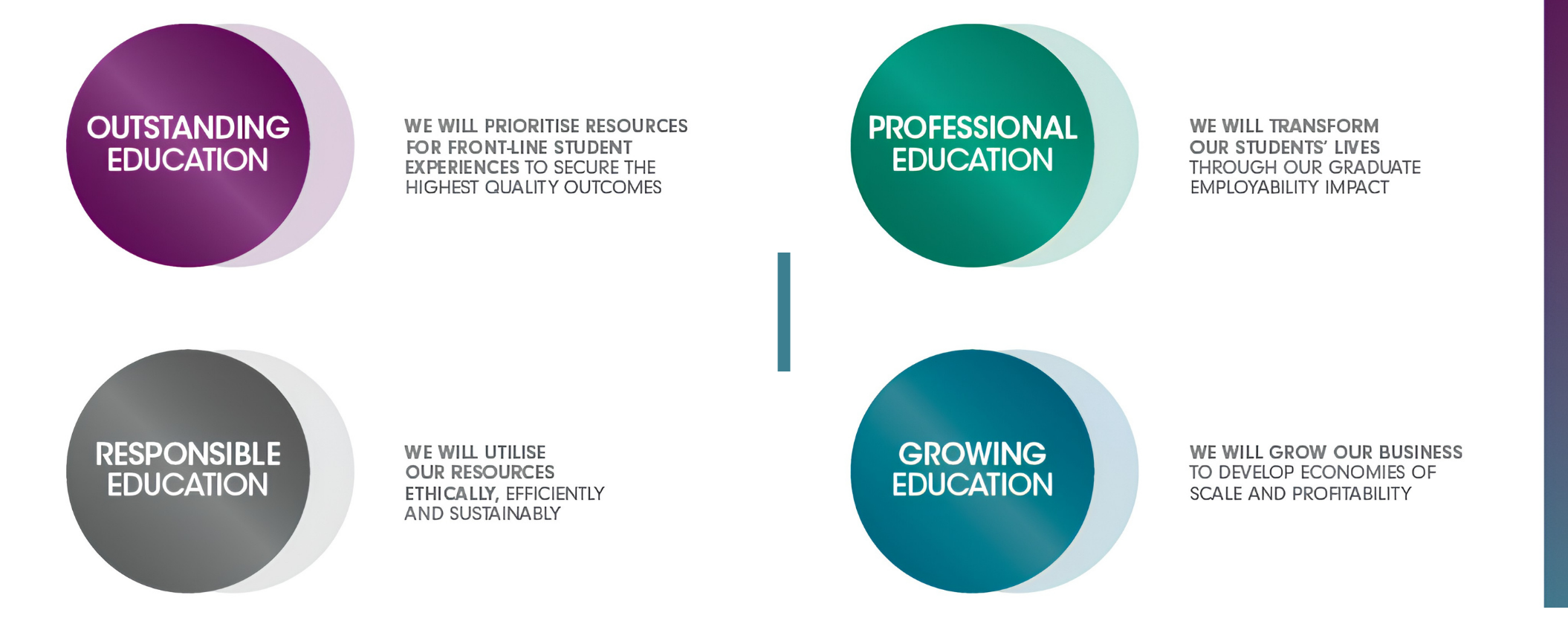
Our strategy, Driving Change, Changing Lives, is more than a plan, it’s a commitment to making a difference. It sets out how we’ll grow, innovate, and lead in professional education.

  • Outstanding Education – Delivering high-quality, inclusive learning experiences.
  • Professional Education – Preparing students for real-world impact.
  • Growing Education – Expanding our reach and sustainability.
  • Responsible Education – Embedding ethical and sustainable practices.

But strategy alone doesn’t shape success, people do. That’s why our culture and values are central to how we deliver our vision.

We’re building a culture that:

  • Encourages collaboration and curiosity.
  • Values trust, integrity and accountability.
  • Supports growth, wellbeing and inclusion.
  • Celebrates achievement and impact.

Our values and behaviours are the everyday actions that bring this culture to life. They help us make better decisions, build stronger relationships, and stay focused on what matters most. Together, they connect our purpose to our practice, and ensure that every colleague, in every role, contributes to a university that’s changing lives.


WE ACT WITH INTEGRITY AND TAKE RESPONSIBILITY TO DELIVER A HIGH-QUALITY SERVICE AND EDUCATION

Be Ethical Act with fairness, honesty, and transparency. Uphold high standards and ensure your decisions reflect our values.
Be Accountable Own outcomes, take responsibility for actions and decisions, and raise issues constructively with solutions in mind.

OUR STUDENTS ARE AT THE HEART OF EVERYTHING WE DO

Be Empathetic Understand the needs and perspectives of others, and how your role affects the student journey. 
Be Responsive
Act promptly and personally to queries, requests, or feedback.

WE EMBRACE DIVERSITY AND CONNECT ACROSS CULTURES

Be Open-minded Be aware of different perspectives and adjust your thinking.
Be Fair Provide equitable opportunities by recognising individual circumstances.

WE ARE COMMITTED TO DELIVERING OUTSTANDING ACADEMIC EXPERIENCES AND OUTCOMES

Be Innovative Take initiative to improve how we work, explore creative solutions, and collaborate across teams.
Be Consistent Meet agreed standards, attend to detail, and take pride in the quality of your output.

WE WORK TOGETHER IN AN APPROACHABLE AND COLLABORATIVE WAY

Be Approachable Be open, warm, and non-judgemental. Make it easy for people to come to you.
Be Enabling Provide help, resources, and signposting to allow others to succeed independently.

Learn more about our values and behaviours here


Our 2023-2027 strategic plan

Please note: Strategy 2030 is currently in development. 

We are passionate in our commitment to drive and develop new programmes aligned to the needs of employers both within the legal sector and expansion into wider disciplines.

Four themes of our strategy

Our key USPs

Sustainability

We have a priority set of 7 ambitious sustainability targets

  • By Q3 2023 we will have an externally verified carbon emissions baseline.
  • Alumni diversity and ‘Partnership for Impact’ programme in place by 2024.
  • Full ESG Reporting by Q1 2024.
  • 50% of suppliers by spend signed up to a new Sustainable Supply Chain charter by 2025.
  • A wide range of courses on sustainability and law/business by 2026, with commercial traction.
  • Every student to be sustainability literate by the time they graduate, by 2027
  • Implement an Environmental Management System with ISO 140001 and certification by the end of 2027.

View our full sustainability report here.

Investing in our people to deliver our strategy

TALENT ACQUISITION
We will develop our employer brand, value proposition and recruitment practices to deliver growth in our staff body and deliver our strategic goals. We recognise that to fully support our whole student body, we ourselves need to fully reflect the diversity of every individual who chooses to study with us. By 2025, we will have delivered a 20% increase in ethnic diversity and a 10% increase in self-declared disability of our colleagues.

RETENTION
We will develop a colleagues wellbeing group to support our staff through times of change, drive sustainable working and increase the resilience and performance of
our workforce.

ORGANISATIONAL DEVELOPMENT
We will continue to develop our performance and development framework to engage colleagues, and offer clear performance assessment, and career development and promotion routes. Through this we will proactively manage our talent to develop our future management and leadership pipeline. Central to this is our commitment to furthering equality, diversity and inclusion within the University.

We will develop time allowances for Continuing Professional Development, training and external network activities. This will empower our people to bring knowledge from the front line to our students and colleagues, raise performance and raise our voice and impact on the Higher Education sector.

View our full strategic plan here

The role

Chief Technology Officer (AQ3703)

Apply now

Job Title: Chief Technology Officer
Career (R&R) Level: Executive Board Member
Department: Executive Board
Reporting to: Vice-Chancellor/CEO
Direct Reports: 3
Location: TBC (Hybrid UK with some global travel)
Salary: £230k + discretionary bonus

Main Function of Job

The CTO will own and transform the University’s technology vision and lead a large, multi-disciplinary technology function through a pivotal period of modernisation, AI adoption and institutional growth.

Reporting directly to the Vice-Chancellor/CEO, the CTO will be a strategic partner to the most senior academic and professional services leaders across the institution -translating complex technological opportunity into tangible outcomes for our students and employees The postholder will bring both vision and execution credibility and will be expected to operate with confidence at Board level, in external sector forums, and at the frontline of technology delivery.

Specific Responsibilities

Technology Strategy & Institutional Leadership

  • Develop, own and regularly review a comprehensive multi-year Technology & Digital Strategy – ensuring it is integrated with the University’s Strategic Plan and delivers measurable outcomes across academic activities of the University and its operations.
  • Translate institutional priorities into clear technology roadmaps with defined milestones and KPIs.
  • Conduct regular technology horizon scanning to identify emerging platforms, tools and methods relevant to higher education.
  • Serve as a full member of the Senior Leadership Team (SLT) and University Executive Board, contributing to institutional strategy and decision-making beyond the technology function.
  • Champion the role of technology as an enabler of competitive differentiation and student experience improvement.
  • Establish and chair a Technology Governance Board comprising academic, business professional, and student representation to oversee investment prioritisation and strategic delivery.
  • Develop and manage the University’s total technology investment portfolio, including capital expenditure, operational spend, and commercial partnerships.
  • Accountable for technology risk at institutional level – maintaining a technology risk register and reporting regularly to the Audit and Risk Committee and University of Law Board.
  • Represent the University’s technology position externally – including to the Office for Students (OfS), UKRI, Jisc and sector peers – shaping the national higher education technology agenda.

Digital Transformation & Innovation

  • Establish and lead a university-wide Digital Transformation Programme, with executive sponsorship, clear governance, and transparent delivery reporting to the Executive Board.
  • Define transformation scope including student journey digitisation, research platforms, administrative modernisation, and campus infrastructure.
  • Introduce programme and portfolio management disciplines (e.g., agile delivery, benefit realisation frameworks) where these are nascent.
  • Lead the migration from legacy to secure, resilient, and cost-effective cloud platforms. Oversee architecture decisions across SaaS, PaaS, and IaaS, ensuring fit-for-purpose solutions across the student lifecycle, HR, finance, and research systems. Manage the decommissioning of end-of-life systems while minimising operational disruption.
  • Drive the modernisation and integration of the University’s core enterprise systems – including Student Information System (SIS), Virtual Learning Environment (VLE), ERP, CRM and HR platforms.
  • Champion a culture of user-centred design and evidence-based service improvement, using data and student/employee feedback to continuously iterate digital products.
  • Identify and incubate technology innovation opportunities – working collaboratively with teams across the University and external partners to pilot new approaches to learning, research, and knowledge exchange.
  • Establish and embed a formal Technology Innovation Framework, including a funded innovation pipeline, proof-of-concept process, and route to scale for successful pilots.

Artificial Intelligence & Data Strategy

  • Define and lead the University’s AI Tech Strategy, covering the responsible use of generative AI, machine learning, and automation across teaching, research, operations, and student support. Develop clear institutional policy on student and staff use of AI tools (e.g. generative AI in assessment and AI-assisted research workflows). Engage academic leaders, the Academic Board, and student representatives in shaping AI policy – balancing innovation with academic integrity.
  • Build a group-wide Data Strategy encompassing data architecture, governance, quality and literacy. Establish a University Data Governance Framework with clearly defined data ownership, stewardship, and accountability across all faculties and directorates. Oversee the development of a central data platform (Data warehouse / Lakehouse) that consolidates institutional data and enables analytics at scale.
  • Commission and oversee AI and data analytics use cases that deliver tangible value -including student retention prediction, personalised learning recommendations, resource planning, and research impact measurement.
  • Ensure all AI and data initiatives are developed and deployed ethically, in compliance with UK GDPR, the ICO’s AI guidance, and the University’s own ethical frameworks. Establish an AI Ethics Review process in collaboration with legal, compliance and academic.
  • Build institutional data and AI literacy – working with the People & OD team and other key departments to develop training programmes that equip all employees with the skills to engage confidently with data-driven tools.
  • Monitor and respond to emerging UK and EU AI regulation (EU AI Act, ICO guidance, Bletchley process outcomes), ensuring the University is well-positioned to comply.

Technology Operations & Cyber Security

  • Ensure the design and operation of a resilient, high-availability technology infrastructure across all campuses, remote working environments, and digital services. Oversee network, compute, storage, and end-user device strategy, including campus Wi-Fi, managed desktop, and BYOD provisions.
  • Define and maintain Service Level Agreements (SLAs) for all technology services, with robust monitoring, incident response and continual improvement processes.
  • Lead the University’s cyber security strategy and programme, in line with Cyber Essentials Plus, NCSC guidance, DSPT, and higher education sector frameworks. Commission and act on independent penetration testing, red team exercises and cyber risk assessments. Maintain and regularly test a comprehensive Business Continuity and Disaster Recovery (BC/DR) plan. Oversee the University’s Security Operations Centre (SOC) function – whether in-house, outsourced or hybrid.
  • Lead the University’s compliance posture across all relevant data protection and technology regulations. Ensure compliance with UK GDPR, the Data Protection Act 2018, PECR and any sector-specific obligations. Maintain productive relationships with the ICO, NCSC, Jisc CSIRT and relevant government agencies.
  • Oversee technology procurement strategy and vendor management, including framework agreements, contract governance and supplier performance management. Ensure value for money across the technology estate – regularly benchmarking spend against sector norms and renegotiating contracts where appropriate.
  • Manage the University’s technology asset lifecycle – from procurement and deployment through to secure disposal – in line with environmental sustainability commitments.
  • Drive environmental sustainability through technology – including energy-efficient data centres, responsible hardware procurement, and contribution to the University’s net zero targets.

People, Culture & Capability

  • Provide strategic leadership to a technology function of approximately 60 employees, spanning infrastructure and operations, software development, data and analytics, digital services, cyber security and IT support. Build and maintain an effective technology leadership team, providing coaching, development, and clear accountability at every level. Establish a clear organisational design for the technology function that balances centralised governance with faculty and departmental responsiveness.
  • Foster a high-performance culture characterised by psychological safety, intellectual curiosity, user focus and continuous improvement. Champion agile and product-led ways of working, moving the function from project delivery to ongoing product stewardship where appropriate.
  • Develop and implement a Technology Workforce Strategy that addresses skills gaps, succession planning, and talent pipelines – including graduate schemes, apprenticeships, and partnerships with local education providers.
  • Lead the University’s technology-specific learning and development programme – ensuring staff are equipped to work with modern platforms, methodologies and tools.
  • Build institutional technology capability beyond the central IT function – embedding digital skills and data literacy across faculties, professional services and student-facing roles.
  • Champion equality, diversity, and inclusion within the technology function – creating a collaborative environment where all colleagues can thrive in line with the ULaw Way.
  • Drive effective performance management – setting clear objectives, providing regular feedback, and addressing underperformance constructively and promptly.

Stakeholder Management, Governance & Board Engagement

  • Serve as the primary technology voice at the Executive Board level – presenting technology strategy, investment proposals, risk reports, and transformation updates to the Board and its committees (Audit and Risk, Finance, Remuneration). Translate complex technical matters into clear, accessible language for lay governors and non-executive members. Build trusted relationships with colleagues on the Executive Board, the University of Law Board and committee chairs – providing timely and transparent information.
  • Act as a strategic partner to the Vice-Chancellor and fellow members of the Executive. Co-design business cases for major technology investment with the CFO and relevant budget holders. Provide technology leadership to major cross-institutional initiatives – such as new campus developments, international partnerships or institutional mergers/acquisitions.
  • Build effective working relationships with senior academic leaders across the University and the Academic Board – to understand faculty technology needs and ensure the technology function is genuinely responsive to academic priorities.
  • Establish Faculty Technology Liaison roles or equivalent mechanisms to maintain continuous two-way dialogue.
  • Engage authentically and regularly with students – through the Students’ Union, student representatives on governance committees and direct feedback mechanisms – to understand and respond to student experience priorities.
  • Represent the University in national and international higher education technology forums.
  • Manage the University’s portfolio of strategic technology partnerships – including Microsoft, Google, Oracle, Salesforce, or other major platform vendors – ensuring contractual value, strategic alignment and continuous innovation.
  • Oversee the University’s engagement with EdTech start-ups, research commercialisation activities and technology transfer opportunities – in collaboration with the Pro Vice-Chancellor (Education) and their team.
  • Oversee the relationship with outsourced providers (to include but not limited to those within the wider GUS family).

In addition to the responsibilities listed above, the job holder may be required to perform other duties as assigned by members of the Executive Board from time to time.

The job holder has a duty to take reasonable care for the health and safety of themselves and of other persons with whom they come into contact at work. The job holder also has a duty to co-operate with the University in complying with any statutory duty or requirement concerning health and safety at work. In particular, they must familiarise themselves with the Health and Safety Policy and its safety and fire procedures.

This job description is to be read in conjunction with the relevant Roles and Responsibilities Career Level document.

This job description is correct at July 2026. It may vary in consultation with the post holder to reflect changes within the marketplace and the University.

Person Specification

All of the following criteria are considered essential unless otherwise noted.

Training & Education

  • Educated to master’s level OR an equivalent professional qualification.
  • Equally, demonstrable equivalent skills development and experience (to include innovation in delivery/thought leadership) which meet the requirements of the role.
  • Relevant professional certifications (e.g., CISSP, TOGAF, AWS/Azure Solutions Architect, ITIL). (Desirable)

Experience

  • Demonstrable experience leading large-scale digital transformation programmes from strategy through to delivery, with measurable outcomes.
  • Experience leading and developing large multi-disciplinary technology teams (typically 50+ employees).
  • Demonstrable experience in budget planning and complex financial management within large organisations.
  • Proven experience in creating and leading successful organisational and culture change, setting strategic objectives and driving implementation.
  • Track record of managing significant technology budgets and complex vendor relationships.
  • Experience developing and implementing AI or data strategies in an organisational setting.
  • Experience in higher education, the public sector or a similarly complex regulated environment. (Desirable)
  • Experience of technology integration across mergers, acquisitions, or multi-campus environments. (Desirable)

Skills & Knowledge

  • Deep expertise across cloud architecture, enterprise systems, cyber security and data/AI platforms.
  • Strong commercial acumen – able to build business cases, negotiate contracts and demonstrate return on technology investment.
  • Familiarity with UK HE regulatory frameworks (OfS, REF, GDPR, Cyber Essentials Plus, Jisc). (Desirable)
  • Knowledge of emerging trends and technologies in higher education (including AI, data science, machine learning, and open research to include knowledge of research computing, open data and/or specialist academic technology platforms). (Desirable)

Behavioural Skills

  • Excellent Board-level communication and governance skills – able to translate technical complexity for non-technical audiences including lay members of the University of Law Board.
  • Exceptional written, verbal, and presentational communication skills combined with political astuteness with a track record of establishing rapport, work collaboratively, instilling confidence and being influential across a diverse range of stakeholder groups.

Special Circumstances

  • Ability and flexibility to travel to different campuses and locations – domestic and international.


Click here to download the job description.

Terms

  • Annual leave & bank holidays: 30 days annual leave, plus bank holidays (pro rata) – a generous holiday allowance which exceeds the statutory minimum.
  • Occupational pay benefits: ULaw offers a range of contractual benefits in excess of the statutory requirements. These include enhanced maternity, paternity, adoption and sick pay.
  • Pension: ULaw’s pension is a salary sacrifice scheme, making it a tax-efficient way to save for your future. The minimum contribution rate from both colleagues and ULaw is 4%. To maximise the benefit, you may choose to contribute a higher amount, with your contribution level being matched by ULaw by up to 6%.
  • Private medical insurance (PMI): Private Medical Insurance is offered to all colleagues, their partners and eligible dependents. The full subscription rate will be paid for full time colleagues and a prorated amount for part-time colleagues. Any additional costs for partners and/or children are met by the colleague.
  • Volunteering leave: All colleagues can take up to 2-days (pro-rata) of paid volunteering leave each year to volunteer with charities and non-profit organisations, which demonstrate positive social or environmental benefit.
  • Gym discounts: Colleagues can benefit from discounts at over 3,000 gyms, health clubs, leisure centres and bootcamps across the UK, as well as sportswear, fitness trackers and nutritional supplements through the MyLifestyle benefits portal.
  • Staff groups: Colleagues are able to join a variety of groups ranging from LGBTQ+, Disabled Staff and Race, Ethnicity and Cultural Heritage (REACH) groups to Living Faith and Parents and Carers.

You can access ULaw’s full benefits and wellbeing brochure here.

How to apply

Anderson Quigley is acting as an advisor to the University. An executive search process is being carried out by Anderson Quigley in addition to the public advertisement.

The closing date for applications is noon on the 3rd of September 2026.

Applications should consist of:

  • A full CV.
  • A covering letter  (2 pages of A4) outlining your motivation and details of how you meet the qualification, skills and experience criteria of the person specification.
  • Please include details of two referees in your CV, though please note that we will not approach your referees without your prior consent and only should you be shortlisted.

Should you wish to discuss further details about the role in strict confidence, please get in touch with Grace Tattersall at grace.tattersall@andersonquigley.com / +44 (0)7510 384 761.