Appointment of the Lay Members of Council (Governor)

University of Kent

Welcome

Thank you for your interest in joining the Council of the University of Kent. We are a leading UK university, combining world class teaching and outstanding support with research that makes a meaningful difference to society. Founded in 1965, the University has grown to become the anchor institution in the county. Our 16,000 students and 3,000 staff are spread across two campuses, in Canterbury and Medway, with a combined economic impact in the region of £0.9bn a year.

Ranked 40th in the UK in the latest Sunday Times University rankings, Kent strives to be an institution that empowers students from a wide range of backgrounds to find and shape their place in the world. Through ambitious changes in the years ahead, we want to put students at the heart of everything we do – with courses that inspire and meet what employers are looking for, an approach that enables everyone in our community to thrive and an environment where students are driven and challenged by academics at the top of their field.

The Council oversees of the conduct of the affairs of the University and the management and administration of its revenue and property. This is a time of unprecedented change and challenge for universities, making it more important than ever that our Council is equipped to navigate well in an unpredictable environment and to protect the continuing role of the University in the region and for its students. We are looking for Council members who can bring experience that will help the University successfully navigate these challenges.

We are now seeking three new lay members to join our Council, at least one of whom must have finance expertise, including a relevant professional qualification. Candidates with skills in legal, audit, HR, or marketing fields would also be highly valued.

We look forward to speaking further with interested candidates and hope you will be inspired to join us.

Mark Preston
Chair of University Council

From the Chancellor

From the Chair of Council & the President of Kent Students Union

ED&I

EDI at The University of Kent is committed to the creation and support of a balanced, inclusive and diverse community.

The University of Kent aims to:

  • Embed EDI practices into all planning processes and functions of the University;
  • Promote and share good EDI practice;
  • Develop, support and implement EDI policies and procedures;
  • Advise on the legislative framework;
  • Supporting staff, students, departments and services with EDI projects and initiatives;
  • Provide relevant and up to date information to all staff and students
  • Support the different equalities networks for staff and students.#

Learn more about our EDI work here.

The Council

The Council is the supreme governing body of the University.  Most of its membership comprises of lay members; other members include staff and student representatives. The Council holds five meetings per year. To see profiles of our Council members, visit our profile page.

Responsibilities of the Council

The Council’s responsibilities include:

  • The oversight of the management and administration of the revenue and property of the University.
  • The oversight of the conduct of the affairs of the University.
  • The appointment of lay officers, including its Chair and the Chancellor, and lay members of the Council.
  • Making and amending of the University’s Statutes (subject to the Privy Council’s approval) and Ordinances.

Principal Committees and Membership

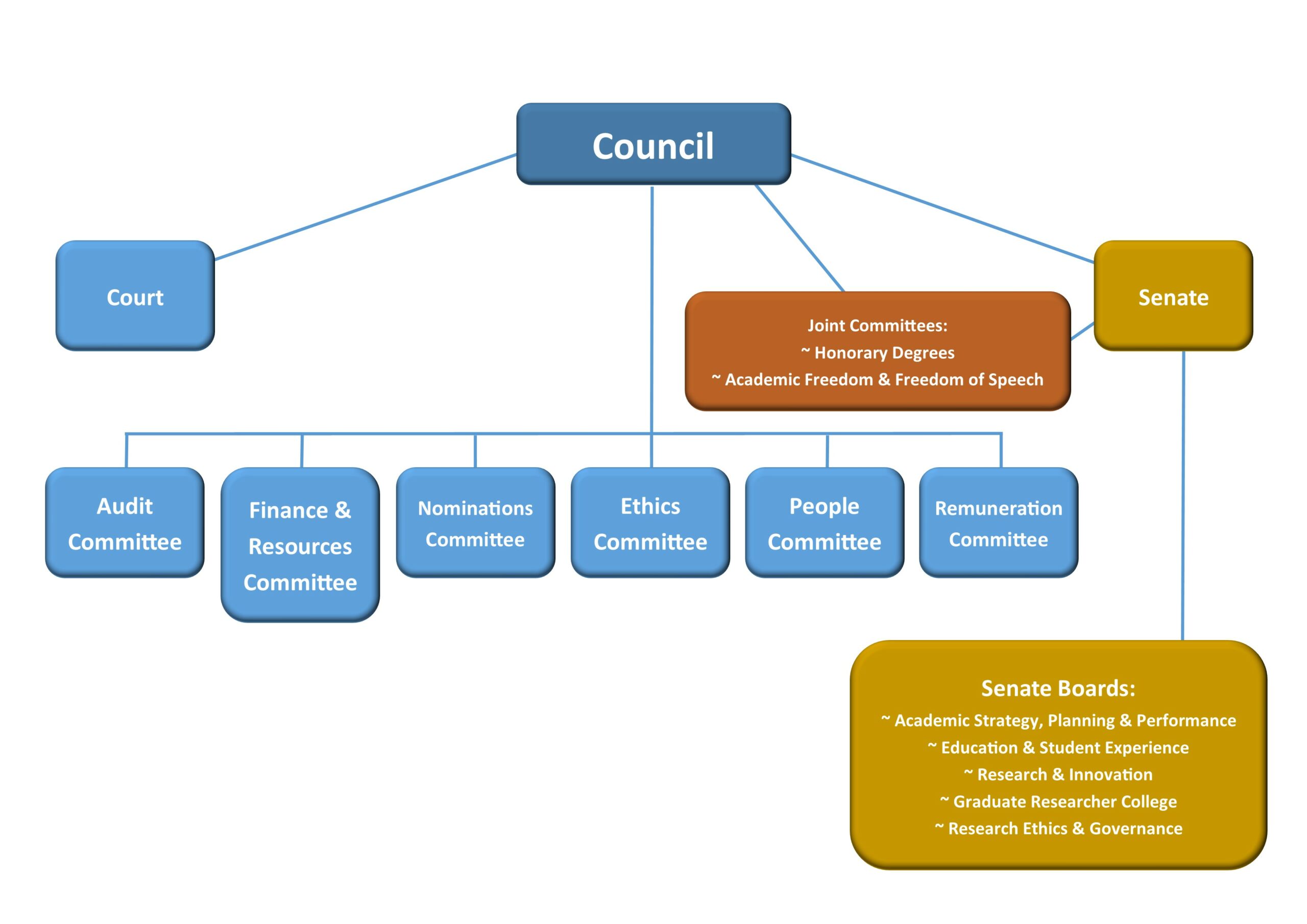
The Council’s principal committees include:

  • Honorary Degrees Committee (Joint Committee of Senate and Council)
  • Audit Committee
  • Ethics Committee
  • Finance and Resources Committee
  • Nominations Committee
  • People Committee
  • Remuneration Committee
  • Joint Standing Committee on Academic Freedom and Freedom of Expression (SCAFFE)

Learn more here.

Our Council structure

Collaboration with the University of Greenwich

The University of Greenwich and the University of Kent have announced the intention to formally collaborate.

The partnership will lead to the creation of a new “super-university”, the London and South East University Group* – a new model bringing both institutions under one structure whilst enabling each university to retain its name, identity and local presence.

The collaboration will be a trailblazing model, establishing a first-of-its-kind multi university group, which will create a blueprint for other institutions to follow. The new university group will become one of the largest higher education institutions in the UK and the largest in the South of England. It will be the biggest recruiter of students in London and the South East.

Professor Georgina Randsley de Moura, Acting Vice Chancellor and President of the University of Kent said: “This exciting collaboration is about harnessing the combined power of two ambitious universities looking to the future, to ensure we are sustainable, impactful and can make a bigger difference to the communities we serve.

“Together, we can deliver world-class teaching, grow research that tackles real-world challenges, and create new opportunities for people and places across our wider region. From supporting health and wellbeing to driving innovation in food, sustainability and the creative industries, our work will have impact locally, nationally and globally. Importantly, we will foster a culture where staff and students thrive, collaborate and succeed together.”

The new ‘super university’ will have one unified governing body, academic board and executive team, and one vice-chancellor. The first vice-chancellor will be Professor Jane Harrington. Students will continue to apply to, study at and graduate from their chosen university, preserving each institution’s identity whilst benefitting from the scale and opportunities of the new group.

The combined entity will provide a strong financial foundation to weather current and future economic challenges, widen access to higher education across South East London and Kent, address skills gaps and inequalities, and increase research capacity, particularly in shared priority areas, such as food and sustainability, health and wellbeing and the creative industries. Its collective power will enable it to tackle real world issues with greater impact locally, nationally and globally.

The two universities are working closely with the Department for Education and Office for Students, both of whom support the sector’s need to evolve to ensure future sustainability and impact and deliver positive outcomes for students.

The detailed work is expected to conclude by the end of the year, with a decision on the implementation timescale shortly after. If approved, it is anticipated the London and South East University Group will be established for the 2026/2027 academic year.

* The name ‘London and South East University Group’ is subject to consultation and is a working name at this stage.

Role of Council:

The Council of the University of Kent will continue to play an essential role in overseeing the final decision making on this ground-breaking collaboration and the necessary legal and structural changes, including the establishment of a new governing body for the London and South East University Group, which is expected to include some members from each of the predecessor governing bodies.

Mark Preston, chair of the Council (Governing Body), University of Kent:

“By coming together under a new single structure, we are creating a model that is bold, innovative and designed to support our needs – and the needs of our students – in the future. It allows us combine our strengths whilst giving us the resilience and scale to push boundaries in research, teaching and partnerships.  This forward-thinking approach is not just about keeping pace with the sector – it’s about leading it.”

Role Description

Lay Member of Council (Governor) (AQ3328)

Apply now

Overview

The University Council has determined to adopt the CUC Higher Education Code of Governance (2020) and in so doing has agreed the following Statement of Primary Responsibilities, in line with the Code. This statement should be read in conjunction with the Statutes and Ordinances. Where there is any ambiguity or unintended conflict, the Charter, Statutes, and Ordinances shall take precedence, and the statement of primary responsibilities shall be updated to reflect the same.

Key duties and responsibilities

  1. To set and agree the mission, strategic vision and values of the institution with the Executive.
  2. To agree long-term academic and business plans and key performance indicators and ensure that these meet the interests of stakeholders, especially staff, students, the local community and alumni.
  3. To ensure that processes are in place to monitor and evaluate the performance and effectiveness of the institution against the strategy, plans and approved key performance indicators, which should be, where possible and appropriate, benchmarked against other comparable institutions.
  4. To delegate authority to the Vice-Chancellor and President for the academic, corporate, financial, estate and human resource management of the institution, and to establish and keep under regular review the policies, procedures and limits within such management functions as shall be undertaken by and under the authority of the Vice-Chancellor and President.
  5. To ensure the establishment and monitoring of systems of control and accountability, including financial and operational controls, risk assessment, value for money arrangements and procedures for handling internal grievances and managing conflicts of interest.
  6. To establish processes to monitor and evaluate the performance and effectiveness of the governing body itself.
  7. To conduct its business in accordance with best practice in HE corporate governance and with the principles of public life drawn up by the Committee on Standards in Public Life.
  8. To safeguard the reputation, good name and values of the institution.
  9. To appoint the Vice-Chancellor and President as Chief Executive and to put in place suitable arrangements for monitoring their performance.
  10. To appoint a Secretary to the governing body and to ensure that, if the person appointed has managerial responsibilities in the institution, there is an appropriate separation in the lines of accountability.
  11. To be the employing authority for all staff in the institution and to be accountable for ensuring that an appropriate human resources strategy is established.
  12. To be the principal financial and business authority of the institution, to ensure that proper books of account are kept, to approve the annual budget and financial statements, and to have overall accountability for the institution’s assets, property and estate.
  13. To be the institution’s legal authority and, as such, to ensure systems are in place for meeting all the institution’s legal and compliance obligations, including those arising from contracts and other legal commitments made in the institution’s name. This includes accountability for health, safety and security and for equality, diversity and inclusion.
  14. To receive assurance that adequate provision has been made for the general welfare of students.
  15. To act as trustee for any property, legacy, endowment, bequest or gift in support of the work and welfare of the institution.
  16. To ensure that the University’s constitution is always followed, and that appropriate advice is available to enable this to happen.
  17. To promote a culture which supports inclusivity and diversity across the University.
  18. In partnership with Senate, to maintain and protect the principles of academic freedom and freedom of speech.
  19. To ensure that all students and staff have opportunities to engage with the governance and management of the University.

Terms of appointment

The role of Council Member is a voluntary position and is unremunerated.

Council members may claim reasonable expenses when attending meetings in person on campus, in accordance with the University’s normal expenses policy for staff.

Remote attendance can be arranged where Council members are unable to be present in person and may be the norm for some sub-committees.

SCHEDULE OF DATES

Council normally meets five times in every academic year.

Dates for Council meetings in 2025/26 are 2nd October 2025, 28th November 2025, 20th March 2026, 15th May 2026, 26th June 2026, all from 2-5pm.

In addition, we hold an annual Strategy Day, which for 2025/26 will likely be on 22nd Jan 2026 (10-4pm).

Council members are normally expected to serve on at least one Council Sub-Committee, as approved by the Lay Nominations Committee taking account of individual lay members’ skills and interests. The schedule of Council Sub-Committee meeting dates for 2025/26 is not yet agreed.

Additional (“extraordinary”) meetings of Council or its Sub-Committees may be arranged on occasion if required for urgent business.

View the Council Calendar for 2025 – 2026 here

How to apply

Anderson Quigley is acting as an advisor to the University of Kent. An executive search process is being carried out by Anderson Quigley in addition to the public advertisement.

CLOSING DATE FOR APPLICATIONS: Friday 19 September, 2025. To apply, please click on the Apply Now button at the top of the page.

Applications should consist of:

  • A full CV.
  • A covering letter outlining your motivation and details of how your skills and experience can meet the needs described in the Primary Responsibilities of the Role Description.
  • Please include details of two referees in your CV, though please note that we will not approach your referees without your prior consent and only should you be shortlisted.

Should you wish to discuss the roles in strict confidence, please contact Elyse Turner-Pearce at elyse.turner-pearce@andersonquigley.com, +44 (0)7808 648 559 or or Helene Usherwood at helene.usherwood@andersonquigley.com, +44 (0)7719 322 669.

Timeline

Closing date Friday 19 September
Longlisting Thursday 02 October
Preliminary interviews with AQ via Teams w/c Monday 06 October
Shortlisting Tuesday 28 October
Final panel interviews at University of Kent w/c Monday 03 or Monday 10 November